Igreja / Museu de São João Baptista
Back to all places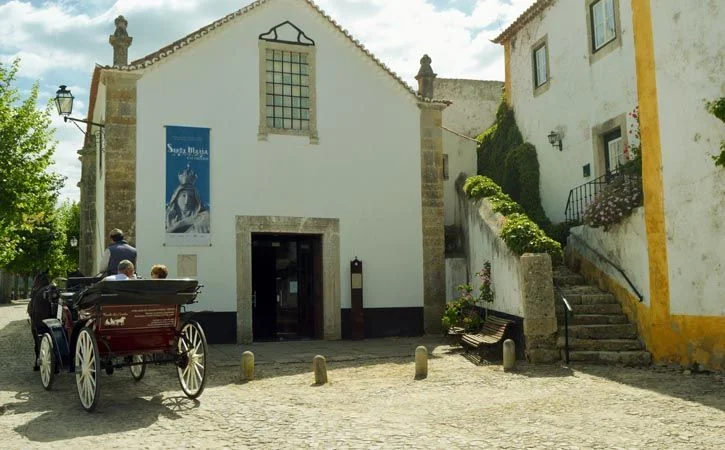
Its origins date back to the end of the 13th century or beginning of the 14th century, when Queen Santa Isabel built a gafaria or leprosarium with a chapel dedicated to Saint Vincent in this location, once far from the village.
However, the configuration that it still presents today results largely from the works carried out throughout the 16th century, after the integration of its assets into the Santa Casa da Misericórdia de Óbidos, founded at the time: a single nave and chancel covered by a vault with pointed ribs. , bearing the Cross of Christ on the central clasp. Communication between the church and the gafaria would be done through a galilee, whose arches are detected inside. In the middle of the same century, under the reign of D. João III, new works were carried out. In fact, it is known that between 1530 and 1550 the nave was enlarged, closing the galilee, and on the outside buttresses and a new portal of classic taste were placed. An altarpiece from Garcia Fernandes’ workshop from around 1540-1550 is also installed, consisting of seven tablets with scenes from the Martyrdom of Saint Vincent, today in the Municipal Museum.
In the middle of the 17th century, the headquarters of the parish of São João Baptista do Mocharro moved to this church, until then based in the church of the same name located outside the walls, a fact that gave rise to new remodeling works, such as the painting of the vault of the chancel with polychrome brutesque motifs. The 1755 earthquake would also have affected the temple, corresponding to that period the bell tower and the current altarpiece in the main chapel, in Rococo carving with a screen representing Saint John the Baptist. In 2003, adaptation works were carried out for the Parish Museum.
39.35875, -9.15807