Igreja de Santa Maria
Back to all places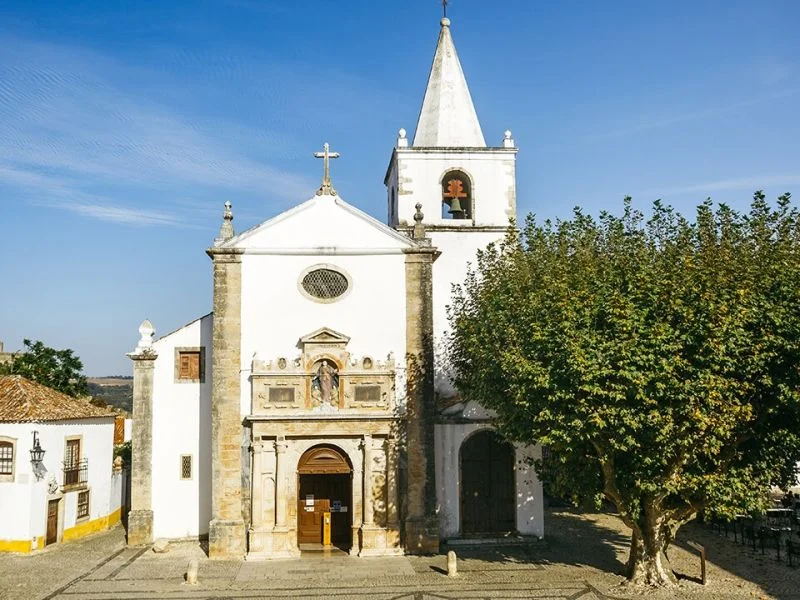
Main church, located in the square of the same name, is the main temple in Óbidos. Mosque in the Muslim period and sacred by D. Afonso Henriques shortly after the conquest of the town in 1148. The exact date of foundation is not known, it is a fact that the priory of the new church was handed over to S. Teotónio, companion of D. Afonso Henriques , great figure of the Church and prior of the powerful Monastery of Santa Cruz de Coimbra, which had the patronage of the Church of Santa Maria until D. João III donated it to his wife, Queen D. Catherine of Austria.
The medieval temple was profoundly renovated by Queen D. Leonor at the end of the 15th century, with work continuing through the first quarter of the 16th century. The bell tower dates from this campaign, attached to the facade and covered by an octagonal pyramidal spire. Certainly hit by the earthquake of 1535, around 1570 it threatened ruin, so that its complete reconstruction was immediately considered. Thus, on August 15, 1571, the day of the Assumption of Our Lady, the first stone of the new church was laid, with a procession and great religious apparatus, with the works continuing under the protection of Queen D. Catarina and Prior D. Rodrigo Sanches, Spanish cleric, chief almoner of the Queen and figure of great prestige in the court of Charles V. This campaign resulted in its current configuration, with a probable design from the royal architect António Rodrigues (Pedro Flor, 2002). About a century later, it underwent new improvement works, on the initiative of Prior Doctor Francisco de Azevedo Caminha, who redecorated the church through an artistic program with a Baroque taste – ceiling, tiles and nave screens.
Outside, the beautiful Mannerist portal stands out, topped by the image of Our Lady of the Assumption, patron saint of the parish, a highly restored composition. It is composed of two pairs of columns that support the pediment with a frieze decorated with finely crafted grotesques and cartouches in the North European style.
Inside, the tomb of D. João de Noronha, the Younger, and his wife D. Isabel de Sousa stands out, classified as a National Monument, as it is one of the most beautiful examples of Portuguese Renaissance tombs. The decoration of the naves of the church of Santa Maria is one of the most outstanding works of all national tiles, it presents the most monumental tile compositions based on the brutesques and the decorative motifs on the ceilings. In painting, the main highlight is the altarpiece of Saint Catherine of Alexandria, painted by Josefa d’Óbidos, possibly the only work executed by her that still maintains its original location. The tops of the side naves have two beautiful paintings by André Reinoso, Baptism in the River Jordan and the Transfiguration, while the central altarpiece structure of the main chapel is attributed to the painter João da Costa in a cycle of eight paintings dedicated to the Virgin Mary. Also noteworthy is the beautiful 17th century pipe organ present in the high choir.
39.36197, -9.15688