Igreja da Misericórdia
Back to all places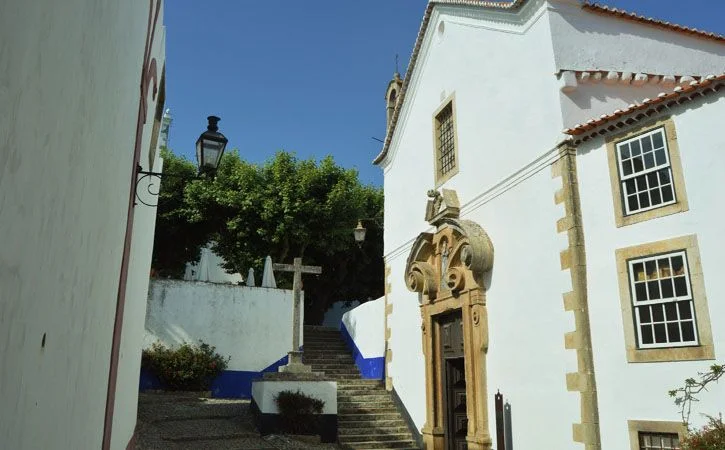
Former Capela do Espírito Santo, the Santa Casa da Misericórdia de Óbidos was founded here by Queen D. Leonor, according to tradition, back in 1498. The church underwent several renovations, mainly from the end of the 16th century, when it was rebuilt, the most important being, at least in its interior, the one carried out in the second decade of the 17th century by the Ombudsman of Mercy and Prior of Saint Peter, Doctor João Vieira Tinoco.
Outside, the bold composition of the portal stands out, topped by a niche with an image of the Virgin and Child made of glazed and painted ceramics, probably produced in Lisbon from 1665 to 1680 (José Meco, 1998). The wooden doors are dated 1623.
The interior, of a single nave, is entirely covered in blue and yellow tiles of a standard or carpet type, due to the textile suggestions in the pattern used (c.1625-30). Noteworthy is the important Mannerist carving set formed by the poll workers’ chair/tribune and the altarpieces. The altarpiece in the main chapel, the work of the carver Manuel das Neves under the design of João da Costa, features two large paintings by André Reinoso – the Visitation of the Virgin to Santa Isabel and Pentecost, from around 1628-1630. The collaterals, also by the carver Manuel das Neves, from 1626, gilded by Belchior de Matos (author of the chair), today house the images of Senhor dos Passos and Nossa Senhora das Dores, both made of “roca”, topped by paintings also by André Reinoso – Christ on the way to Calvary and the Descent from the Cross.
In the middle of the 18th century, the church was renovated once again, as evidenced by the date of 1744 on the facade, which includes the royal shield that tops the church portal, another that tops the triumphal arch, and the painting on the same arch. , the two side closets of the chancel and the ceiling of the nave, with the royal coat of arms in the center. Also noteworthy is the carved stone pulpit, dated 1596, decorated with cartouches and scrolls with a curious urn at the base for collecting offerings, and the 18th century armored tomb slab of the Countess of Knights, D. Luísa Guerra. Of its imagery, the magnificent Crucified Christ of probable Spanish origin (17th century) and the images of the Virgin and Child, Saint Anthony and Saint Joseph stand out.
Attached to this church was the old Hospital da Misericórdia, now converted into a historic inn.
39.36159, -9.15677