Ermida da Nossa Senhora do Carmo
Back to all places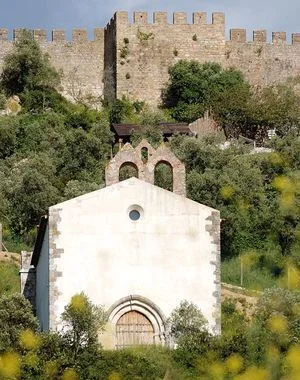
This temple was probably built in the 14th century and was the seat of a parish until the 17th century. It was then known as the Chapel of São João de Mocharro.
This is a Gothic chapel with a doorway with a broken arch, with archivolts resting on cylindrical columns embedded in phytomorphic capitals.
Inside, the temple has a single nave with a wooden ceiling that opens onto the main chapel through a round-arched triumphal arch.
The history of the church of Nossa Senhora do Carmo, which was once dedicated to São João Baptista, is lost in time.
Tradition says that there was once a temple dedicated to Jupiter on this very site. Although archaeological evidence has not yet confirmed this hypothesis, there is no evidence to the contrary. What is certain is that during the Islamic period there was a Christian community here with its church dedicated to São João Baptista, a very characteristic devotion among the Mozarabs.
At the beginning of the Reconquista, this church was repaired or rebuilt, with only a small door on the north elevation surviving from its Romanesque past. The church also underwent major renovations in the 14th and 15th centuries, but its urban periphery gradually fell apart. Many of the activities that sustained the Mocharro community were linked to the Lagoa. With its natural retreat and the artificial silting carried out in the 16th century, many people must have moved to the towns of Arelho and Santa Rufina, on the banks of the Lagoa.
In 1636, the Parish and Collegiate Church of São João asked the Misericórdia de Óbidos to lend them the chapel of S. Vicente, which had previously supported the gafos hospital. The parish agreed to the request and settled in this temple, remaining there until its closure in the 19th century.
Also in the 17th century, the church of São João adopted a new patron saint, being dedicated to Nossa Senhora do Carmo.
From this church, now partially restored after more than half a century of abandonment and ruin, there remains an excellent image of Saint John the Baptist, produced in Coimbra in the 15th century; and the image of Our Lady of Mount Carmel, from 1636, offered by the 1st Count of Óbidos, D. Vasco de Mascarenhas.
39.36322, -9.15875